
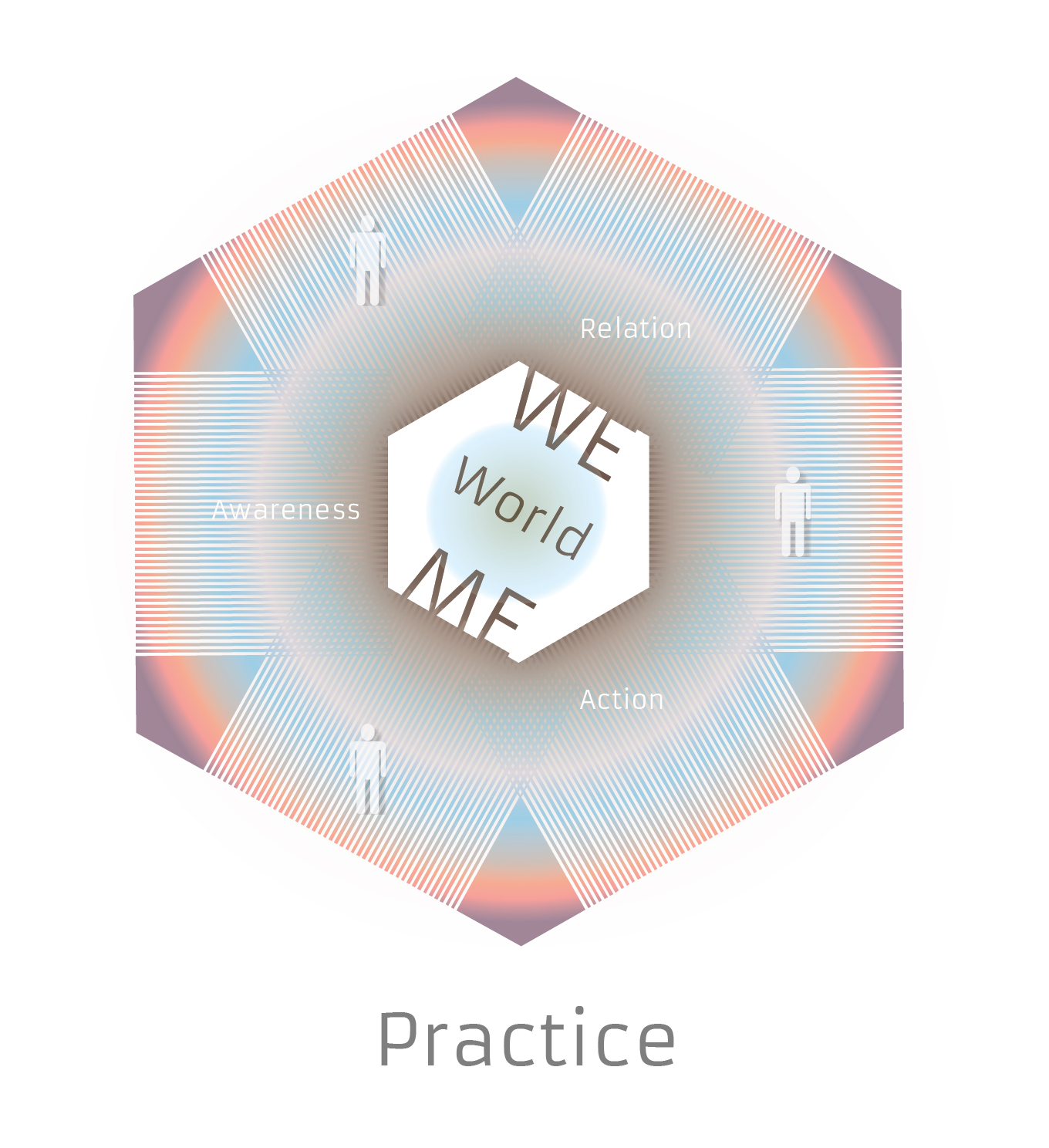
PRACTICE
MWWxSTUART — A Relational Reading Discipline
Me–We–World is not a program for change.
It is a discipline for reading how change frames itself.
MWWxSTUART integrates:
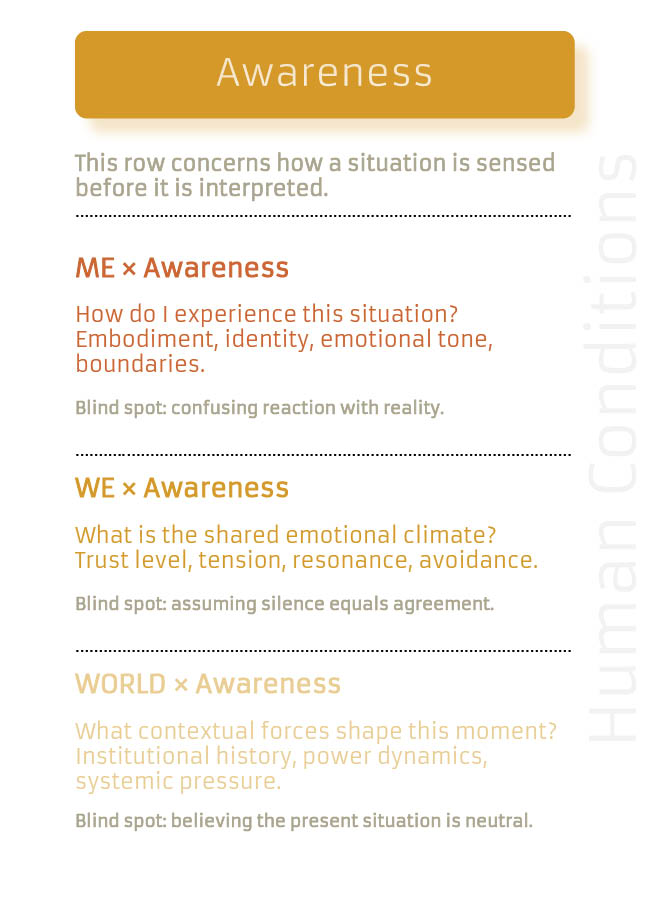
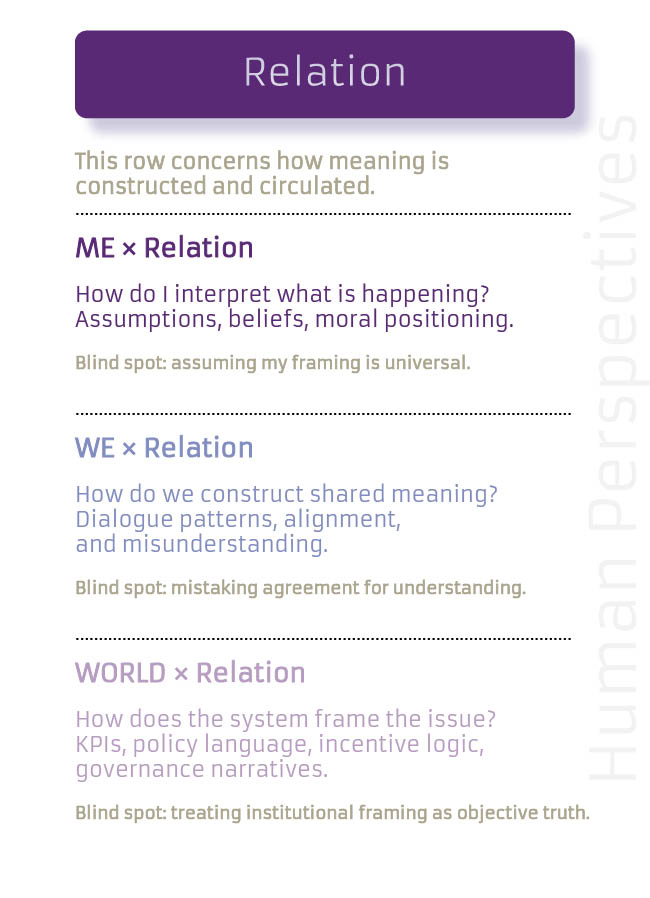
- The Human Field (Awareness – Relation – Action)
- The Structural Lens (ME – WE – WORLD)
- The Ethical Resonance Layer (STUART)
- The Double Lens (Law ↔ Ethics)
Together, they form a relational reading grid.
This grid does not produce answers.
It makes visible how answers are formed.
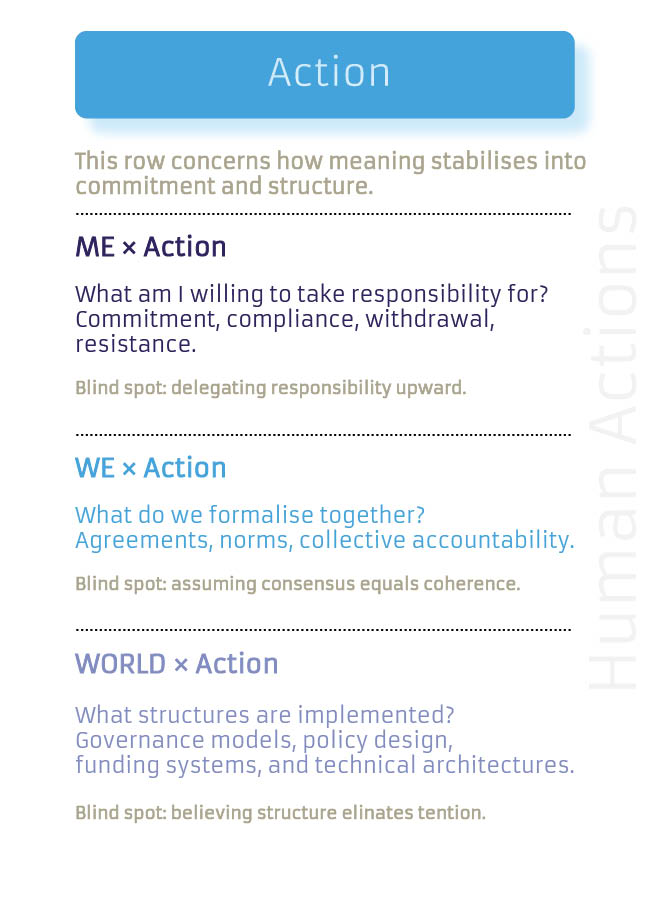
THE RELATIONAL READING GRID
Below is the structural overview of the MWWxSTUART Matrix.
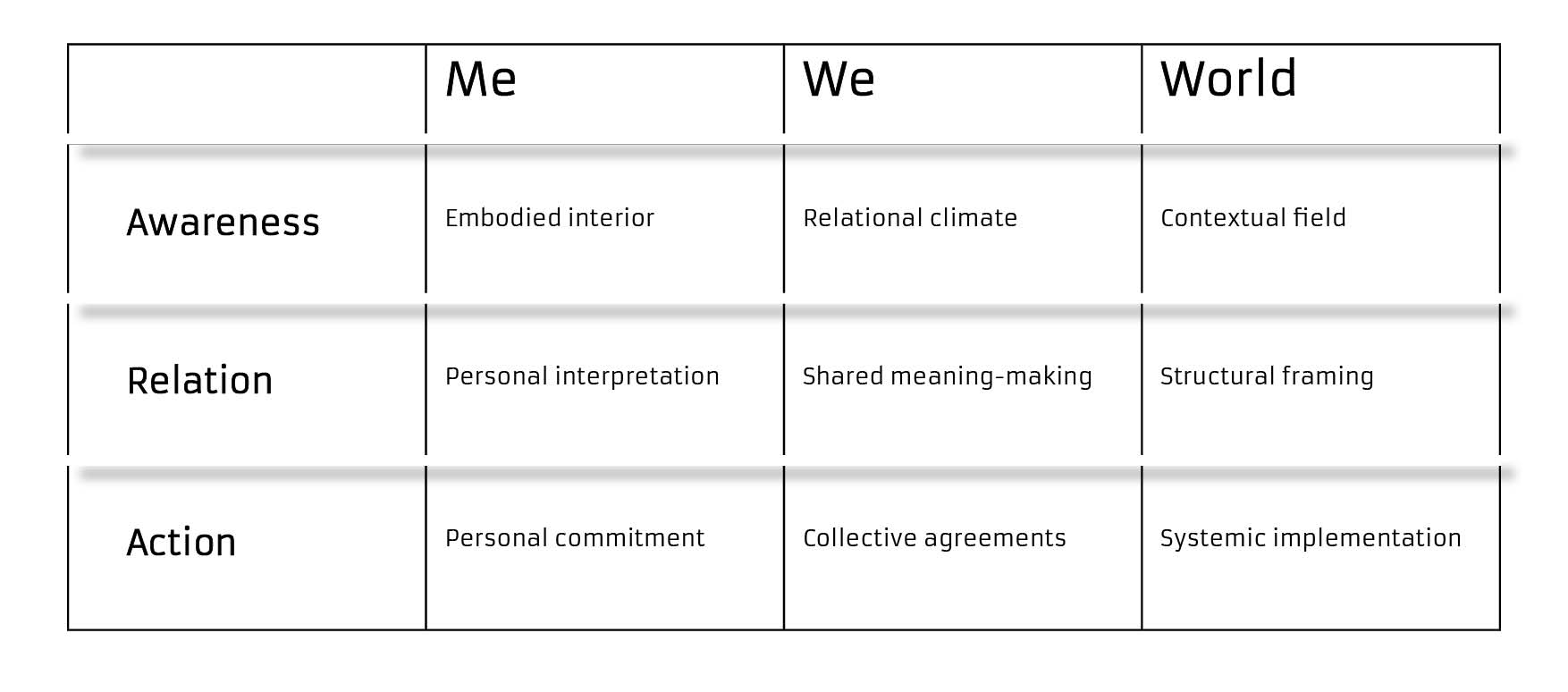
The grid consists of:
Horizontal axis:
ME — WE — WORLD
Vertical axis:
Awareness — Relation — Action
Each field represents a specific dimension of participation.
The matrix is not a decision tool.
It is a perceptual map.
THE OVERLAY DIMENSIONS
The grid becomes fully relational when two additional dimensions are applied across all fields.
STUART — Ethical Resonance
Each field can be sensed through:
Safety
Trust
Understanding
Awareness
Relaxation
Togetherness
STUART does not evaluate decisions.
It reveals how a situation is being held.
For example:
Low Safety in ME × Awareness
Low Trust in WE × Relation
Low Togetherness in WORLD × Action
STUART adds depth without prescribing correction.
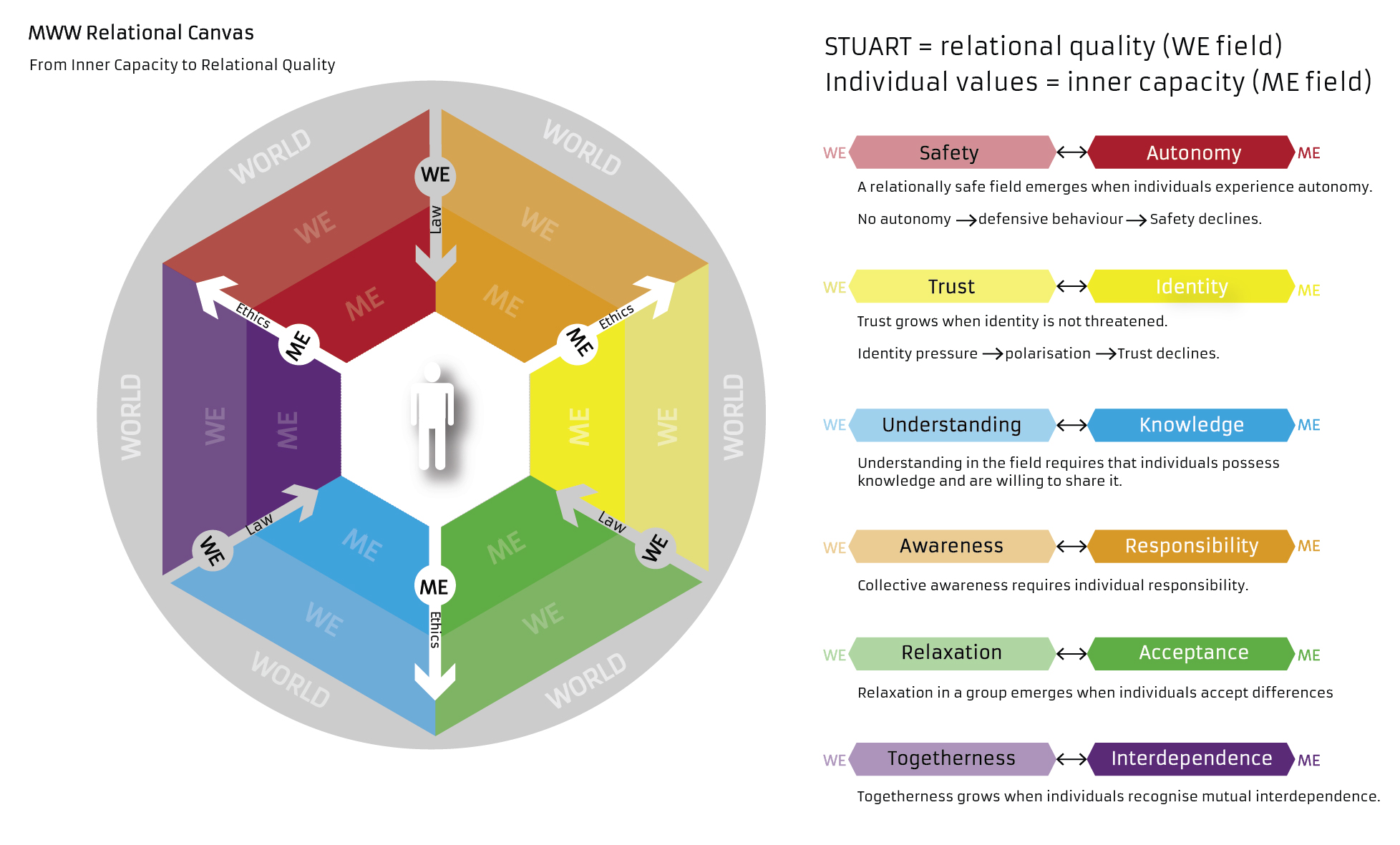
LAW ↔ ETHICS — Legitimacy Axis
Every field contains a tension between:
Law — rules, roles, incentives, compliance
Ethics — care, responsibility, lived experience
The readings do not collapse one into the other.
It keeps the tension visible.
Where Law dominates, structure stabilises.
Where Ethics dominates, sensitivity deepens.
Relational maturity lies in perceiving the oscillation.
WHAT THIS MATRIX DOES
The MWWxSTUART grid makes visible:
- how decisions justify themselves
- why certain criteria dominate
- which perspectives remain structurally absent
- where experience is overridden by structure
- where action precedes awareness
It does not:
- prescribe solutions
- eliminate tension
- provide governance templates
It is a discipline of professional vigilance.
WHERE FRICTION EMERGES
When introduced into practice, the Reading often creates productive tension.
Iteration vs Framing
Improvement within unquestioned premises.
Measurement vs Meaning
What gets counted versus what gets felt.
Governance vs Experience
Structural clarity masking relational strain.
Autonomy vs Interdependence
Individual freedom conflicts with systemic coherence.
This friction signals that hidden assumptions are becoming visible.
FIELDS OF APPLICATION
The Reading applies wherever decisions shape human life.
The structure of the matrix does not change — only the context does.
Governance & Policy
Reveals tension between systemic incentives and lived experience.
Organisations & Strategy
Clarifies how identity narratives shape performance systems.
Commons & Decentralised Systems
Makes visible oscillation between autonomy and interdependence.
Education
Moves learning from information transfer to relational awareness.
Future Literacy & Anticipation
Reveals which futures are structurally imaginable — and which remain excluded.
Technology & AI
Examines how architectures embed ethical assumptions.
Across domains, the Reading deepens situational clarity before action.
CORE STATEMENT
MWWxSTUART is a relational reading discipline that makes visible how situations frame themselves — structurally, ethically and experientially — not to produce better answers, but to prevent us from confusing our answers with reality.